Hi friends!
It’s been a minute since I’ve written in my personal blog. I’ve been busy pouring myself into other creative projects, building things, dreaming things, dancing and vibing. But what better time to resurrect the blog than to unpack my first official experience collaborating with a local promoter?
Short version: I learned a lot.
Longer version: I learned it the hard way.
BEFORE I CONTINUE, PLEASE REMEMBER: What follows is my personal reflection. It speaks only to my lived experience and the lessons I’ve drawn from it. It does not represent any organizations, collectives, or professional collaborations I’m a part of. This is my individual voice, making sense of a moment that shaped me.
So yeah, no, I’m not here to cry in a corner (lolz I already did that). I’m here because I refuse to be a silent lesson!!!
For context, I’m an aerialist: trained in pole, lyra, and flow arts. I grew up performing at international festivals, and I’ve always loved the intersection of movement and music. I’m also deeply embedded in the EDM community. So naturally, my brain thought: why not bridge the two? Why not create a night that feels like a miniature festival with local DJs, live dancers, high energy, immersive atmosphere?
At festivals, aerialists fly above main stages all the time. That inspiration lit a spark. So I reached out to a local EDM promoter to bring that vision to life: an all-local DJ lineup paired with my dance group performing throughout the night, about six hours of performance presence.
When the promoter, the head of the dance group, and I met to brainstorm, he asked what the ticket-sale split should be. We told him we were new to collaborating like this and trusted him to handle the specifics fairly.
No written contract… Lesson learned.
And that’s where this story begins.
We first met in December 2025. During that initial brainstorming session, he asked how we wanted to structure the ticket profit split. Since we were genuinely excited about the concept and new to collaborating in this way, we trusted him to handle the financial specifics fairly with the head of the dance group if there was profit to split.
What wasn’t disclosed in that meeting was that “most events lose money,” or that there was a real possibility this could end up being unpaid labor (more on this later below). Had that been made clear upfront, we could have consciously decided whether we were okay volunteering our time or negotiated a minimum guarantee or stipend.
For additional context: I’m part of the dance group, not the head of it. I personally wasn’t pursuing this for profit. I was the liaison, the bridge, trying to merge two communities I love. But even if I wasn’t expecting to personally profit, I also wasn’t expecting my entire dance group to receive nothing. When he asked how we wanted to split ticket sales, I naturally assumed that meant some form of compensation was part of the framework. Like… forgive me for not assuming that ‘collaborating’ with him meant free labor…
That assumption turned out to be the fault line.
The event itself was a hit!
Great turnout, strong community feedback, people loved the added dance performance element!! ~150 tickets sold at $20 each. Afterward, the promoter told us there was no profit to split and $0 for the dance group, because the event “lost money”… He messaged us saying that most of their events lose money and that the goal is simply to break even and give the community a unique experience. He also added that since we never agreed on a specific ticket split or percentage, he isn’t expecting us to share in “the loss”.
Here’s where things started to unravel for me.
When I asked to see the budget breakdown, I saw that he had paid himself for 62 hours of labor at $15/hour (about $930), along with additional line items for graphic design and overhead. I’ll post the full breakdown below so you can see it for yourself.
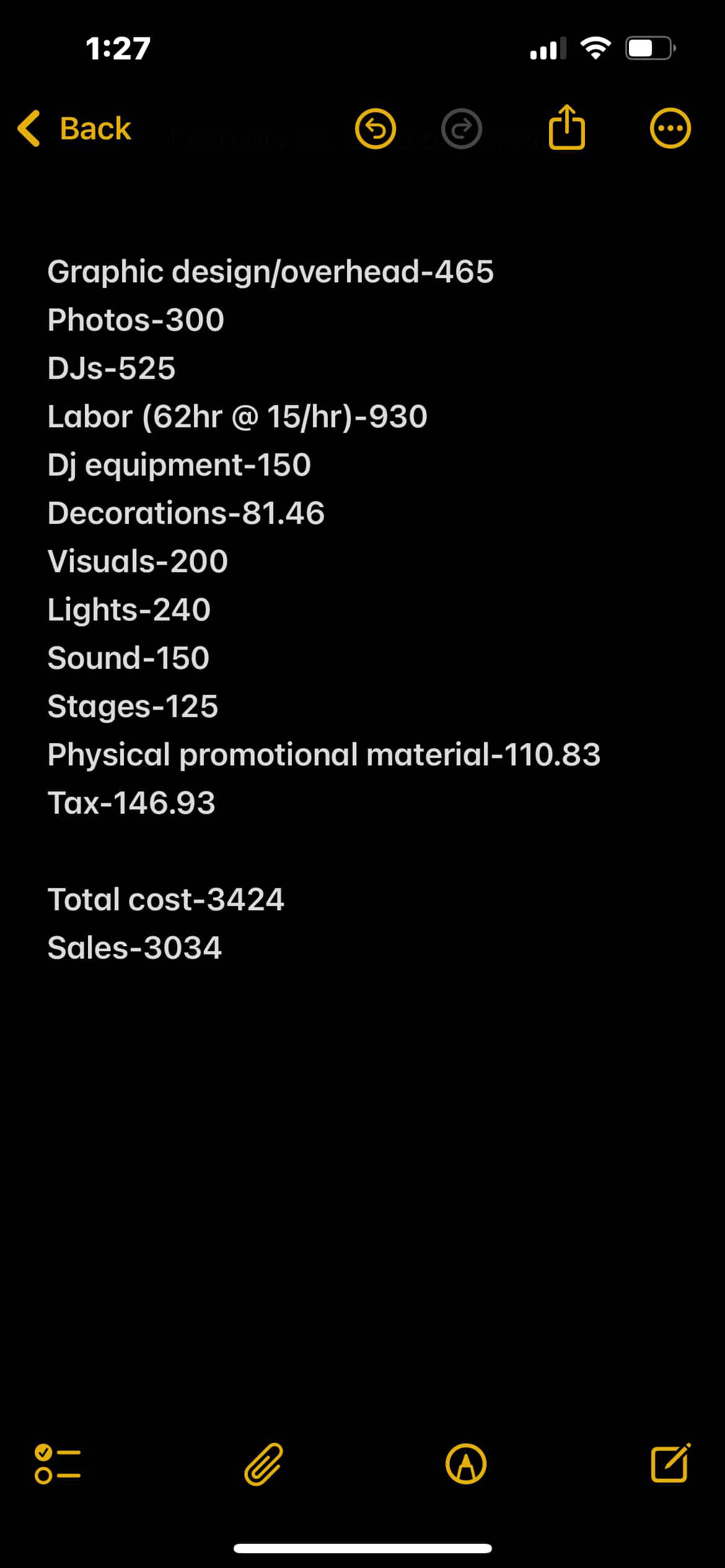
Meanwhile, our dance group wasn’t included as a budgeted expense at all.
I also DJ’d that night and was paid $60 for a 45-minute set, which I appreciated. But the dance group, who performed throughout the event for 6 hours, received nothing.
Oh! And the ‘loss’ magically went down when I asked for the breakdown, initially he stated the event lost ~$800 after paying out production, then when asked to see the budget it’s now down to a ~$400 loss because one of the DJs turned down the payment (oh, lol, damn was he supposed to get $400 for his set??, but you still didn’t offer our dance group that portion of the budget?)
Anywaysssss
He also referenced a previous collaboration where an event lost money and he had to “split the loss” with the collaborator because they had agreed on a ticket split. And that’s when the bigger pattern started to click for me.
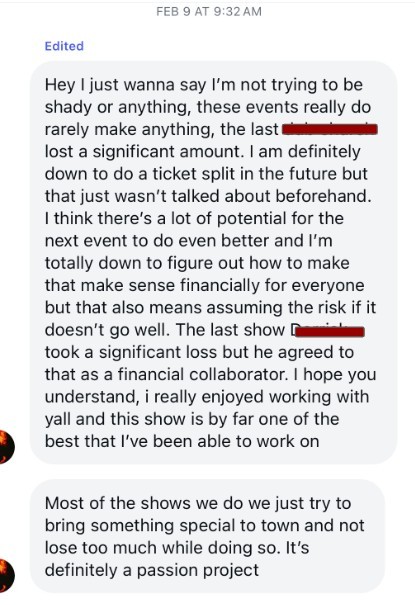
It began to feel like this:
- If you agree to a split, you risk being told the event “lost money” and now you share the loss.
- If you don’t agree to a split, you risk being told the event “lost money” and you get nothing.
In either case, the ‘collaborator’ absorbs the downside.
And that’s when I realized it wasn’t just about this one night. It was about the structure. It was about where risk resides and who is expected to carry it.
The confrontation
If I’m being completely honest, what triggers me the most isn’t even the money.
It’s that I didn’t clock it as off at first… I was still riding the high from performing and feeling elated at the positive feedback from the guests that attended.
I even made an Instagram Reel/Mini Vlog about the experience…

When he sent the message about the event losing money and how most of their shows are “passion projects,” I didn’t feel angry. I didn’t feel bamboozled. I actually responded positively. I was still riding the high of the night. It really was such a fun time. The energy was good. The concept worked. The community showed up.
I didn’t want to taint the magic by nitpicking numbers. I didn’t want to be the one who turned something beautiful into a business dispute.
So I stayed in celebration mode.
It wasn’t until a few days later (when I told my friends, when I sat down with the head of the dance group) that something started to feel off… The adrenaline had worn off. The glow had softened. And the structure became visible. (Shout out to having great friends who don’t sugar coat things and truly care about you).
I think the delay is what messes with me. Why didn’t I see it immediately? Why didn’t I question it right away?
Now I understand the importance of ironing out details beforehand. Now I know the questions to ask before agreeing to collaborate.
And still… even with that awareness, the message itself felt strange.
Even if we had agreed to a split percentage, the logic still feels circular. If the event “lost money,” would we then be expected to share that loss? If the show was such a hit, if turnout was strong, if the energy was undeniable, why is the outcome framed as a loss?
And if this was such a success, what exactly was different? Could it, perhaps, be because there was a new entertainment element added? Could it be, perhaps, the presence of the dancers? I ask that with a healthy dose of sarcasm, but also genuine curiosity.
Because when something changes and the result improves, it is worth acknowledging what contributed to that shift…
His other rationale was that all other EDM events in the area always loses money and the goal is to break even… REALLY?! If so, do y’all also follow this same structure?!? (≖_≖ ) If so, seems like y’all are just bad at budgeting or you’re also following this same structure… (¬`‸´¬)
What does reddit have to say?
Of course, I did what any modern-day creative in mild existential crisis would do… I turned to Reddit.
Partly for perspective. Partly to make sure I wasn’t losing my mind. Because after receiving paragraphs upon paragraphs of justification, I genuinely didn’t know how to respond, react, or even interpret what was happening. It started to feel like I was the unreasonable one for expecting performer labor to be budgeted.
So I asked the internet.
And the consensus?
I was not crazy.
In fact, many seasoned DJs and promoters said the same thing: performers should be budgeted as a baseline expense. Period.
Here’s the full thread if you want to read through it.
Also… go ahead and look at the top upvoted response.
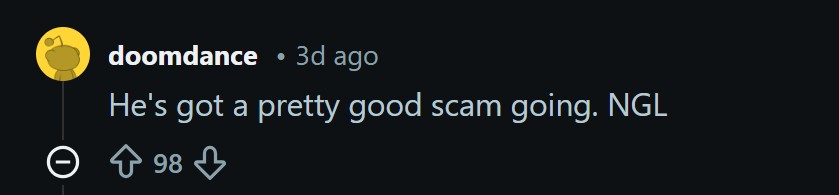
sips tea
Lessons learned (for you and me)
First, I fully own the lack of a contract and the lack of clear communication about compensation. That part is on me. I now understand how important it is to iron out the financial structure before the creative energy takes over.
And to be clear, I wasn’t fighting for some massive chunk of ticket sales. I’m genuinely just shocked that the dance group, as a collaborator, received $0 for organizing performers, rehearsing, coordinating logistics, and performing for 6 hours.
Ironically, I was paid $60 for my opening DJ set. And I’ll be honest, that part makes me uncomfortable. Why was I compensated individually, but the dance group that added a whole layer of entertainment to the night wasn’t?
That’s the disconnect I can’t ignore.
So here’s what I’ve learned:
- Always get compensation expectations in writing, even if it feels awkward.
- Clarify whether compensation is a flat fee, minimum guarantee, door split, or profit-dependent.
- Ask upfront: “Is there a possibility this event loses money? If so, how is that handled?”
- Ask what the estimated expenses are and where collaborators fall in the budget structure.
- Clarify whether performers are considered a baseline expense or only paid from profit.
- If doing a split, define what “expenses” include and whether there’s a spending cap.
- Confirm how and when budgets will be shared.
- Define deliverables on both sides, including content, promotion expectations, and timeline.
- Agree in advance on how losses are handled so risk is truly shared, not assumed.
- Decide whether you are collaborating as a volunteer passion project or as a compensated professional. Those are two different lanes.
- Protect your time the way promoters protect theirs.
- If you are the bridge between communities, clarify your role and make sure it is respected structurally, not just verbally.
- Never assume that “collaboration” automatically means equitable compensation. Define it.
This experience didn’t make me cynical. It made me clearer.
Creativity deserves structure. Community deserves transparency. And performers deserve to be budgeted.
Afterword
I needed to write this.
Not because of the dollar amount. Not because I want to cancel anyone, but because this small experience mirrors something much larger.
When labor that creates value is treated as optional, when those in control of structure define the terms after the fact, when the word “community” is used as a cushion for uneven power dynamics, it starts to resemble something familiar. It resembles the broader systems we live inside. Systems where those in charge normalize exploitation under the language of passion, risk, or shared sacrifice. Systems where resources generated by the many are controlled by the few.
This isn’t just about one event.
It’s about how easy it is to romanticize unpaid labor when it benefits the vision of someone in control.
I’m speaking up because not everyone feels safe doing so. Not everyone has the emotional bandwidth to process it publicly. Not everyone wants to risk social friction in a small scene. And I understand that. I almost stayed quiet too.
But silence is often what allows these patterns to continue.
I care deeply about community. Not in a transactional sense. Not in a profit-driven sense. I care about it because it is relational, cultural, creative. And precisely because I value it in a non-monetary way, I feel responsible for protecting it from being monetized unevenly.
Calling out exploitative structures is not anti-community. It is pro-accountability.
And finally, I want to be clear: these reflections are my own. They represent my personal experiences, interpretations, and growth. They are not affiliated with, nor do they reflect, the professional organizations, creative collectives, or collaborative ventures I am a part of. This is my individual voice, processing an individual experience.
If nothing else, I hope this serves as a reminder that passion and fairness can coexist. Vision and structure can coexist. Community and compensation can coexist.
And they should.
With lots of love, light, and accountability,
BBZL